 T-PACK
OR-T 260/450 ORGAPACK Strapping Machine Repair – Fixing Wire Tightening, Welding, Boards and Motors
OR-T 260/450 strapping machine repair is a technical service for businesses, factories and factories that are using ORGAPACK OR-T 260 and OR-T 450 battery-powered handheld plastic strapping machines. During operation, the machine may encounter problems such as failure to tighten the wire, weak tightening force, slipping tightening wheel, failure to weld the wire, easy to peel the weld, not cutting the wire, not powering up, or reporting an error on the screen.
These damages can disrupt packaging operations, reduce productivity, and affect the sturdiness of the package.
PACKAGING SOLUTIONS CO., LTD. T-PACKreceives inspection, maintenance and repair of the ORGAPACK OR-T 260/450 strapping machine, assists in identifying the cause and advises on treatment plans in accordance with the actual situation.
Hotline/Zalo repair of strapping machine OR-T 260/450: 0326 416 666
1. Introduction of ORGAPACK OR-T 260 and OR-T 450 strapping machines
ORGAPACK OR-T 260 and OR-T 450 are two series of battery-powered handheld plastic strapping machines, which integrate the functions of tightening, welding, splicing and cutting plastic straps.
Both models use friction welding technology, no need to use a bug to link the two ends of the wire.
ORGAPACK OR-T 260 Strapping Machine
The OR-T 260 is a series of battery-powered strapping machines suitable for a wide range of industrial carton, pallet and bale packaging applications.
The machine is capable of adjusting the tightening force, welding time and operating mode, helping users choose the right parameters for the packaging material.
ORGAPACK OR-T 450 Strapping Machine
The OR-T 450 is a series of battery-powered strapping machines designed for applications requiring higher tightening forces, especially strapping industrial bales using PETwires.
The machine has a tensioning and friction welding mechanism, which meets the needs of heavy package packaging when using the correct wire specifications and specifications.
Despite the similar principle of operation, the OR-T 260 and OR-T 450 do not use exactly the same in terms of configuration, tightening force and some mechanical details. When repairing, it is necessary to correctly determine the model and version of the device.
2. OR-T 260 and OR-T 450 Specification Sheet
| Parameters | ORGAPACK OR-T 260 | ORGAPACK OR-T 450 |
|---|---|---|
| Trademarks | ORGAPACK | ORGAPACK |
| Model | OR-T 260 | OR-T 450 |
| Machine Type | Battery Strapping Machine | Battery Strapping Machine |
| Power Supply | 18V Li-ion Battery | 18V Li-ion Battery |
| Wire Type | PP/PET | Mainly PET |
| Wire Gauge | 12–13mm, 15–16mm | 15–16mm, 18–19mm |
| Tightening Force | Approx. 400–2,500N, depending on wire type and mode | Approx. 1,200–4,500N |
| Welding method | Friction welding | Friction welding |
| Function | Tightening, welding, cutting | Tightening, welding, cutting |
| Operating Mode | Automatic, semi-automatic, manual | Automatic, semi-automatic, manual |
| Application | Cartons, pallets, packages | Heavy industrial pallets and packages |
Note: The above parameters are for reference to identify the device. The actual wire gauge, tightening force and configuration need to be confirmed according to the corresponding machine stamp, version and technical documentation.
3. Common errors when repairing the OR-T 260/450 strapping machine
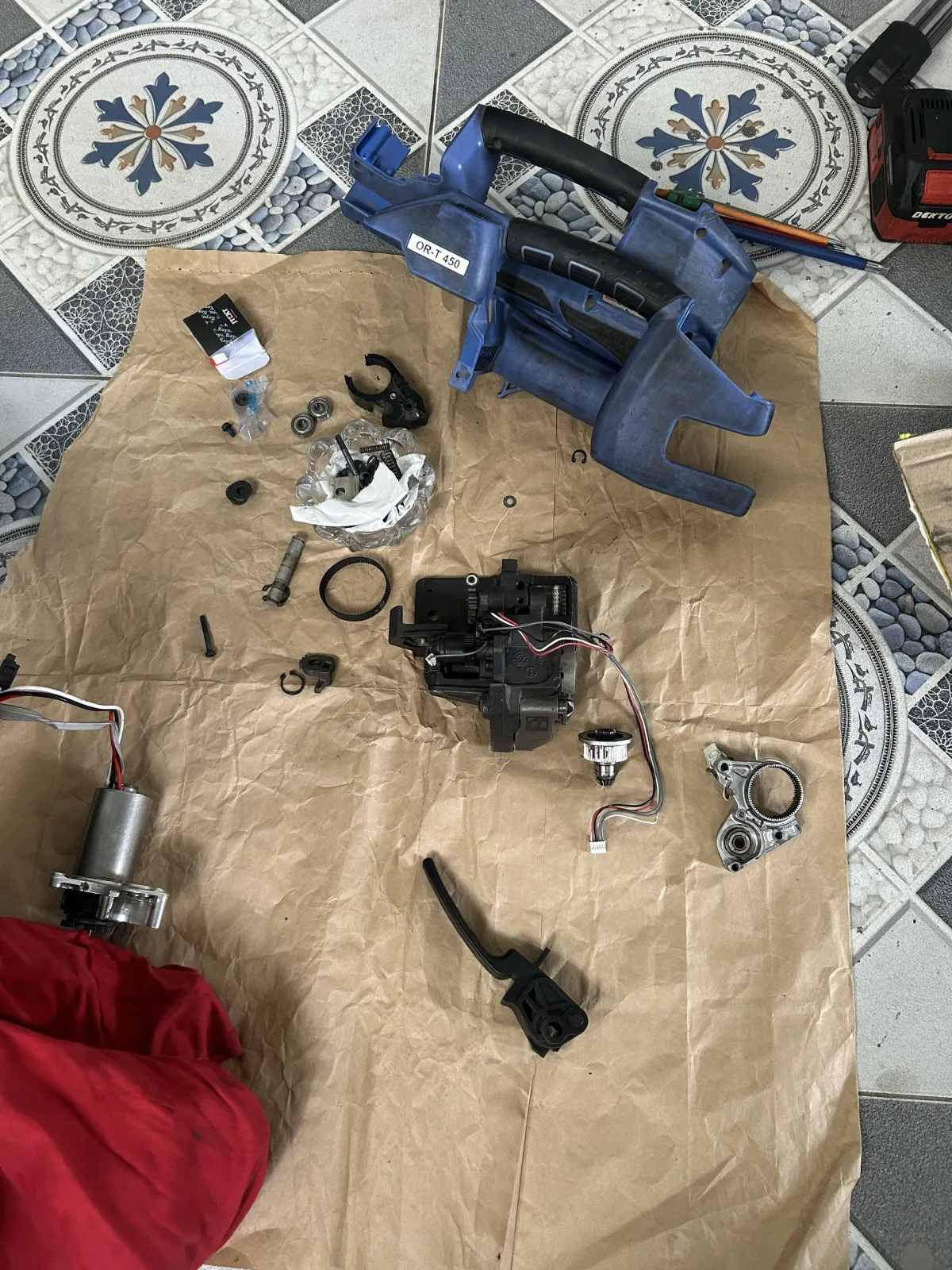
3.1. Repairing the OR-T 260/450 machine that cannot tighten the wire
This is one of the common errors when the machine has been operating for a long time.
Manifestation:
Press the tighten button but the machine does not run.
The motor works but the cord is not stretched.
The machine only pulled the wire for a short time and then stopped.
The wheel tightens but the wire slips.
The machine does not reach the set tightening force.
Possible causes:
Low battery or unstable battery contact.
The tightening wheel is worn.
The cord retaining plate is worn or collected with plastic dust.
The actuator is jammed or worn.
The tightening motor is working abnormally.
The controller has an error.
The belt is not suitable for the machine configuration.
Repair plan:
The technician needs to check the battery power, tightening wheel, wire retaining plate, actuator, and motor.
After determining the cause, carry out cleaning, adjustment or replacement of the damaged part if necessary.
3.2. The OR-T 260/450 machine tightens the wire weakly, with insufficient tension
Manifestation:
The machine still pulls the rope but the rope does not hug the bale tightly, or the actual tightening force is lower than the set level.
Possible causes:
The tightening force setting is not suitable.
The tightening wheel is slipping.
The wire retaining plate is worn.
The battery does not meet the requirements when the machine is under load.
The actuator is worn out.
The motor is weak.
The straps are not in the right specifications.
Processing direction:
It is necessary to check the setting parameters, battery condition and the entire tensioning mechanism.
Especially with the OR-T 450, it is not recommended to increase the tightening force without determining the cause because the large pull force can damage the rope or package.
3.3. Fixing the OR-T 260/450 machine that slips when tightening
The tightening wheel and the wire retaining plate are parts that are subject to friction during operation.
After use, the contact surface may wear out or accumulate plastic dust.
Manifestation:
The wheel rotates but the cord is not tensioned.
The wire is abraded at the pulling position.
The machine does not reach the desired tightening force.
The machine frequently stops during the tightening process.
Causes:
The wheel wears out the teeth.
The wire retaining plate loses grip.
Plastic dust sticks a lot.
The cord is too thin or unsuitable.
The rope holding force mechanism is not working properly.
Treatment plan:
Inspect and clean the tightening wheel, wire retaining plate, and guide mechanism.
If the worn parts exceed the limit of use, they need to be replaced with components suitable for each model.
3.4. Repairing the OR-T 260/450 machine that fails to weld wires
Both models use friction welding technology to join two layers of plastic wire.
Manifestation:
The machine can tighten but not weld.
The soldering kit does not work.
The machine performs the welding cycle but the two layers of wire are not sticky.
An error message appears on the screen.
The soldering unit makes an abnormal noise.
Possible causes:
The installation welding time is not suitable.
The welding mechanism is dusty or jammed.
The welding plate is worn.
The welding motor or drive mechanism has a problem.
The controller did not issue the correct command.
The straps are not suitable.
Repair plan:
Check the welding timing setting, oscillating mechanism, welding plate, motor and control system.
After repair, it is necessary to run a test run with a suitable belt and check the quality of the joint.
3.5. OR-T 260/450 machine welds non-stick wires, easy to peel off welds
Manifestation:
Two layers of wire are only partially sticky.
The weld is easy to peel off when subjected to loads.
The wire is burned or deformed at the welding site.
The weld is uneven.
The weld has a lot of molten resin spilling out on both sides.
Possible causes:
The welding time is too short or too long.
The welding plate is worn.
The pressing mechanism does not generate enough force.
The welding vibration unit works unstable.
The straps are not suitable.
The operator lifts the machine when the cycle is not complete.
Processing direction:
It is necessary to check the welding time, pressure, vibration mechanism and wire quality.
It is not recommended to continue to use the machine for packaging important packages when the weld is not satisfactory.
3.6. Repairing the OR-T 260/450 machine without cutting the belt
After completing the tightening and soldering process, the machine needs to cut off the excess wire.
Manifestation:
The machine finished welding but the wire did not break.
The knife cuts only part of the wire.
The cord is torn or deformed.
The cutter does not work stably.
Possible causes:
The cutter is worn or chipped.
The cutting mechanism is jammed.
The knife drive unit has a problem.
Straps of inappropriate thickness.
The navigation details are skewed.
Repair plan:
Check the cutter, stroke and associated drive mechanism.
Depending on the actual condition, carry out cleaning, adjustment or replacement of the part accordingly.
3.7. Fixing the OR-T 260/450 does not power up
Manifestation:
Insert the battery but the display does not light up.
The machine does not respond when the button is pressed.
The machine starts flickering.
The display turns off abnormally.
Possible causes:
The battery is out of power or damaged.
The battery is not installed in the correct position.
The battery contacts are dirty or damaged.
The power supply circuit has a problem.
The electronic controller is faulty.
Processing direction:
The battery and contacts need to be checked first.
If the cause has been ruled out from the battery but the device still does not power up, it is necessary to check the electrical system and controller.
3.8. Fixing the board of the strapping machine OR-T 260/450
The control board is responsible for managing the operating functions of the machine.
Signs that may be related to the board:
The machine does not receive tightening or welding commands.
The display is abnormal.
The machine stops in the middle of the cycle.
The machine keeps giving errors.
Unstable operation.
The device does not power up even though the battery is normal.
However, not all of the above errors come from the board.
The technician needs to check the battery power, electrical connections, control buttons, motors, and mechanical mechanisms before concluding.
Repair or replacement of the board must be based on the results of the actual test and the availability of compatible components.
3.9. Motor Repair of Strapping Machine OR-T 260/450
Motors and actuators directly affect the ability to tighten wires and friction welding.
Manifestation:
The motor does not work.
The motor runs weakly.
The generator makes strange noises.
The machine stops while under load.
The motor works but the mechanism does not move.
Possible causes:
The motor is damaged.
The drive gear is worn.
The drive mechanism is stuck.
The battery power is unstable.
The controller has a problem.
A general inspection should be done before deciding to repair or replace the motor.
4. Strapping machine fault summary table OR-T 260/450
| Phenomenon | Causes to be checked | Processing direction |
|---|---|---|
| The machine does not power up | Battery, contacts, board | Check the power supply |
| The machine does not tighten the cord | Motors, tightening wheels, transmissions | Tightening Mechanism Inspection |
| Tighten the weak cord | Force Setting, Battery, Tightening Wheel | Tightening Force Test |
| Wire slip | Tightening wheel, wire retaining plate | Cleaning, wear assessment |
| No wire soldering | Welding unit, motor, control | Welding Mechanism Inspection |
| The weld is peeling off | Welding time, pressure, belt | Weld Inspection |
| Do not cut the cord | Cutters, drives | Cutter Inspection |
| Fault Reporter | Battery, control, mechanical mechanism | Reconcile error codes |
| The machine runs weakly | Battery, motor, drive | Under Load Test |
| Strange Noise Transmitter | Gears, bearings, welders | Stop the machine and check |
5. The OR-T 260/450 strapping machine indicates an error on the screen
The ORGAPACK OR-T 260 and OR-T 450 machines have a system that displays the operating status and error messages.
Groups of incidents can be related to:
The battery is low or unsuitable.
Abnormal device temperature.
The wire tightening mechanism is jammed.
The welding unit is not working properly.
The cord is slipped or broken.
The strapping cycle is interrupted.
The control system has a problem.
When the machine reports an error, users should take an accurate picture of the screen, record the time when the error occurred and the operation being performed.
The error code should be compared with the documentation of the correct model and model. The error code of the OR-T 260 should not be applied to the OR-T 450 without confirming compatibility.
6. Inspection and repair process of OR-T 260/450 machine at T-PACK
Step 1: Receive device information
Customers provide OR-T 260 or OR-T 450 models, machine pictures and fault description videos.
Step 2: Check the battery and power supply
Evaluate battery health, contacts, bootability, and error messages.
Step 3: Check the wire tightening mechanism
Check the tightening wheel, wire retaining plate, actuator, and tensionability.
Step 4: Check the friction welding mechanism
Evaluate the condition of the solder unit, pressing mechanism and joint formation.
Step 5: Check the cutter
Check the ability to cut wires and related drive details.
Step 6: Check the motor and controller
If necessary, conduct an in-depth inspection of the electrical and transmission components.
Step 7: Consult on repair plans
After determining the cause, T-PACK discuss with the customer about the treatment plan and the expected cost.
Step 8: Commissioning and post-repair inspection
Check the belt tightening, welding, and cutting functions that are suitable for each model.
7. Proper maintenance of the OR-T 260/450 strapping machine
To limit damage, businesses should pay attention to periodic maintenance of the machine.
Cleaning the tightening wheel and rope retaining plate
Remove plastic dust accumulated during use using the right method.
Welding Parts Inspection
Monitor weld quality and contact surface condition.
Cutter Inspection
If the cutting knife is not decisive, it should be checked before resuming operation.
Battery storage
Use suitable batteries and chargers, avoid excessively hot or humid environments.
Drive Mechanism Inspection
Monitor the squeak and stability when the machine is operating.
Remove the battery before servicing
The battery must be removed before deep cleaning or disassembling the internal parts of the machine.
Do not put your hands in the area of the tightening wheel, welder, and cutter when the machine is capable of operating.
8. When should the OR-T 260/450 be sent for repair?
Businesses should check or send the machine for repair when the following signs appear:
The machine does not power up.
The machine cannot tighten the cord.
The tightening force decreased abnormally.
The tightening wheel slips frequently.
The weld is not strong.
The machine does not cut the cord.
The machine reports the fault continuously.
The motor makes a strange noise.
The machine stops suddenly while in operation.
The device does not work stably after checking the battery and cleaning.
Early inspection helps limit the risk of damage spreading to other parts.
9. Quotation for fixing the strapping machine OR-T 260/450
The cost of repairs depends on the actual condition and extent of damage.
Items that may affect quotations include:
Check the battery power.
Cleaning and maintaining the tightening mechanism.
Check the tightening wheel.
Check the wire retaining plate.
Repair the welding mechanism.
Check the cutter.
Check the motor.
Check the control board.
Replace components as needed.
T-PACK receive information to advise on appropriate inspection plans and quotations.
Hotline/Zalo: 0326 416 666
10. Why should you choose the OR-T 260/450 strapping machine repair T-PACK ?
T-PACK operating in the field of machinery, materials and industrial packaging technical solutions.
For the ORGAPACK OR-T 260/450 strapping machine, T-PACK support:
Receive and advise on damage.
Check the wire tightening system.
Check the friction welding mechanism.
Check the wire cutting unit.
Evaluation of battery, motor, and board failures.
Consulting on machine maintenance.
Propose repair plans according to the actual situation.
The goal is to correctly identify the cause of the damage and help the customer restore stable packaging operations.
11. Frequently Asked Questions About Fixing Strapping Machine OR-T 260/450
Can the OR-T 260 machine not tighten the wire be fixed?
Depending on the cause. The tightening wheel, wire retaining plate, motor, battery, and controller should be checked to determine a repair plan.
What is the problem with the OR-T 450 weakening?
This may be due to a tightening force setting, a slippage tightening wheel, wear out of the actuator, or unstable battery power.
Is the OR-T 260/450 machine welding wire peeled off the welding unit?
Not necessarily. It is necessary to check the welding time, wire quality, pressure, and condition of the welding mechanism.
Do the OR-T 260 and OR-T 450 use the same components?
Not all components are shared. It is necessary to check the part code and machine version before replacing.
Does the OR-T 260/450 not power up have a broken board?
It is not possible to conclude yet. The battery, contacts, and power supply system should be checked before determining a board fault.
Does the OR-T 450 machine use a 19mm PET belt?
The OR-T 450 has a configuration that supports 18–19mm PET wires. It is necessary to check the correct version and wire thickness limits.
Does the OR-T 260/450 use compressed air?
Nope. These are two models of battery-powered strapping machines.
Do T-PACK accept OR-T 260/450 machine repairs?
Yes. Customers contact T-PACK to discuss the status of the machine and the plan to receive the inspection.
12. Contact OR-T 260/450 strapping machine repair at T-PACK
If your ORGAPACK OR-T 260 or OR-T 450 strapping machine is experiencing no tightening , weakening, slippage, no soldering, loose solder joints, not cutting wires, not powering up, or reporting a screen error, please contact T-PACK for advice on inspection and repair.
T-PACK PACKAGING SOLUTIONS CO., LTD
Service: Inspection, maintenance and repair of the ORGAPACK OR-T 260/450 strapping machine.
Hotline/Zalo: 0326 416 666
Website: https://t-pack.vn/
Customers are advised to send machine images, fault videos, and display error codes for initial evaluation support.
T-PACK – Solutions for repairing battery-powered strapping machines and industrial packaging equipment.