 T-PACK
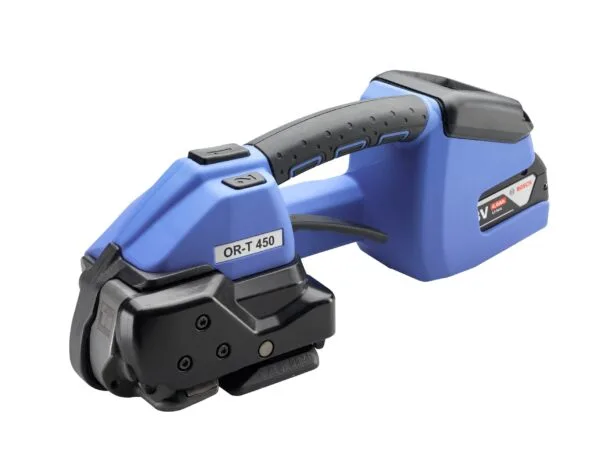
Battery Powered ORT 450 ORGAPACK Strapping Machine
- Strap Type
- PET (Polyester) / PP (Polypropylene)
- Strap width
- 16 mm / 19 mm
Product code: ORT-460 · T-PACK
01 / 12 Product images
Tap an image to zoom · swipe to change view| Parameters | Values |
|---|---|
| Product Name | Strapping machine OR-T 460 |
| Model | OR-T 460 / ORT 460 |
| Trademarks | ORGAPACK |
| Brand origin | Switzerland |
| Machine Type | Battery Operated Portable Plastic Strapping Machine |
| Type of wire used | PET / PP |
| Wire Width | 15–16 mm / 18–19 mm |
| Wire Thickness | 0.8–1.3 mm |
| PET rope tension | 1,300–4,500 N |
| PP rope tension | 400–1,600 N |
| Wire Pulling Speed | 0–150 mm/s |
| Welding method | Friction Welding |
| Weld Strength | Approx. 75–85%* |
| Operating Mode | Automatic / Semi-Automatic / Manual |
| Battery | Bosch Li-ion 18V – 4.0Ah |
| Reference charger | Bosch GAL 1840 CV |
| Charging Time | Approx. 65 minutes to 100% |
| Weight with battery | Approx. 4.2 kg |
| Dimensions | 367 × 152 × 138 mm |
| Working Temperature | -10°C to +40°C |
Contact
Products
Genuine OR-T 460 ORGAPACK strapping machine – 4,500N tightening force, 18V battery
The OR-T 460 Strapping Machine (ORT 460) is a battery-powered handheld plastic strapping equipment belonging to the OR-T Series of ORGAPACK – a Swiss brand, specializing in heavy-duty cargo strapping applications. The machine has a maximum tension of 4,500 N, supports PET and PP belts of 15–19 mm, integrates three functions of automatic tensioning, friction welding and wire cutting on the same device.
With its wireless design, electronic tension adjustment, and three operating modes, the OR-T 460 is suitable for manufacturing plants, logistics, the wood industry, building materials, mechanics, and businesses that frequently strapped heavy pallets.
PACKAGING SOLUTIONS CO., LTD T-PACKprovides and consults OR-T 460 strapping machine solutions, PET/PP straps and related accessories, meeting the needs of industrial packaging.
Hotline for technical advice and quotation: 0326 416 666
ORGAPACK is a Swiss brand of industrial strapping equipment, belonging to Signode Switzerland GmbH, known for its line of handheld strapping tools and industrial strapping systems.
In the OR-T Series battery strapping machines, the OR-T 140, OR-T 270 and OR-T 460 models are designed to meet different requirements for tension, wire size and baling properties.
The ORGAPACK OR-T 460 is a version for heavy-duty applications, using plastic straps up to 19 mm in width and a maximum PET tension of 4,500 N.
Unlike manual strapping kits that use separate strapping devices, press pliers and belt locks, the OR-T 460 combines strapping stages in a single device.
Operators can use the machine at various locations in the workshop, especially for large packages, which are not convenient to move to the fixed strapping machine.
Tensions PET to 4,500 N: meet a wide range of heavy-duty strapping applications.
Use PET and PPwires: supports 15–16 mm and 18–19 mm wire gauges.
Friction welding technology: bonding two wire ends without the use of iron bugs.
Three operating modes: automatic, semi-automatic and manual.
Bosch Li-ion 18V battery: convenient to move and use in the factory.
EasyTrigger technology: supports more convenient belt insertion and retrieval operation.
Adjustable tension and welding time: helps to set the parameters suitable for each type of wire.
Specialized design for industry: suitable for packaging environments with high working intensity.
| Parameters | Values |
|---|---|
| Product Name | Strapping machine OR-T 460 |
| Model | OR-T 460 / ORT 460 |
| Trademarks | ORGAPACK |
| Brand origin | Switzerland |
| Machine Type | Battery Operated Portable Plastic Strapping Machine |
| Type of wire used | PET / PP |
| Wire Width | 15–16 mm / 18–19 mm |
| Wire Thickness | 0.8–1.3 mm |
| PET rope tension | 1,300–4,500 N |
| PP rope tension | 400–1,600 N |
| Wire Pulling Speed | 0–150 mm/s |
| Welding method | Friction Welding |
| Weld Strength | Approx. 75–85%* |
| Operating Mode | Automatic / Semi-Automatic / Manual |
| Battery | Bosch Li-ion 18V – 4.0Ah |
| Reference charger | Bosch GAL 1840 CV |
| Charging Time | Approx. 65 minutes to 100% |
| Weight with battery | Approx. 4.2 kg |
| Dimensions | 367 × 152 × 138 mm |
| Working Temperature | -10°C to +40°C |
Reference parameters according to the ORGAPACK datasheet. The weld strength depends on the wire quality, welding conditions and test method. The battery and charger configuration needs to be confirmed according to the actual product set.
Technical notes: A tension of 4,500 N is equivalent to approximately 459 kgf. This is the maximum rope tension of the device, not the maximum load of the package that the machine can strapp.
The selection of machines and belts must be based on the characteristics of the package, the bearing capacity of the wires, the number of belt loops and transportation conditions.
The OR-T 460 works on the basis of an electric motor wire tensioning mechanism and friction heat sealing technology.
A strapping cycle consists of three main stages:
Once the PET or PP rope is wrapped around the package and properly positioned in the machine, the pulling wheel mechanism will apply tension to the rope.
The operator can set the tension in accordance with the wire type and packaging requirements.
For PETwires, the tension is adjustable between 1,300–4,500 N. For PPwires, the machine uses a lower tension range, from 400–1,600 N.
The use of proper tension keeps the package in place while limiting wire breakage or product deformation due to over-tightening.
After reaching the established tension, the machine performs the process of welding two layers of overlapping wires.
The welding mechanism creates frictional movement at the contact surface, generating heat to soften the plastic material at the joint area.
When the welding process is finished and the splice is stable, the two layers of wire form a bond without the use of metal belt locks.
The quality of the weld depends on many factors such as:
Composition and belt quality.
Wire width and thickness.
Soldering time.
Condition of the welded structure.
Whether the wire surface is clean and dry.
After the welding process, the cutter is integrated in the residual wire section cutting machine, completing the strapping cycle.
This mechanism reduces the number of tools that need to be used, and at the same time is more convenient for continuous strapping tasks.
One of the notable improvements on the new generation of OR-T is the EasyTrigger technology.
This mechanism is designed to assist the operator in inserting and removing the cord from the machine with more convenient operation than traditional manual opening mechanisms.
For factories with a large number of packages, reducing repetitive operations can help improve the operating experience and reduce fatigue.
In addition, the balanced body design gives the user better control over the equipment when working on suitable baling surfaces.
The OR-T 460 strapping machine is equipped with three operating modes, which allow the process to be adapted to the packaging requirements.
Automatic Mode
The machine performs an automatic strapping cycle after being activated according to the setting. This mode is suitable for repetitive jobs and bales with relatively uniform characteristics.
Semi-Automatic Mode
Allows the operator to be more active in the rope tensioning process and move on to the welding stage. This mode is useful when closing bales with different characteristics.
Manual Mode
The operator can control the manual operation of the device, which is suitable for situations where the tightening process needs to be adjusted.
The choice of mode should be based on product characteristics, tension requirements and actual operating procedures.
The OR-T 460 is designed to use PET and PP plastic straps within the allowable size range.
PET (Polyester) rope is often used in industrial packaging due to its high tensile strength and relatively good tension retention.
When combined with the OR-T 460, the PET wire is suitable for applications such as brick pallets, wood bales, building materials, mechanical products, and heavy-duty cargoes.
The machine supports 15–16 mm or 18–19 mm wide PET wires, 0.8–1.3 mm thickness according to the published technical range.
PP (Polypropylene) wire has different properties and range of applications than PET, which is often used for packages with lower tension requirements.
The OR-T 460 has its own tension mode for PP, ranging from 400–1,600 N.
Recommendation: For heavy packages using 19 mm PET wire, it is recommended to check the wire quality, tensile strength, thickness, and weldability before batch operation.
The wire should not be selected based solely on the nominal width.
The OR-T 460 strapping machine uses an 18V Bosch Li-ion battery system.
According to ORGAPACK's reference technical documentation, the 4.0Ah battery configuration has a charging time of about 48 minutes to reach 80% and about 65 minutes to reach 100% capacity under the manufacturer's test conditions.
The number of strapping cycles per charge depends on the tension:
| Tension Level | Number of Reference Cycles |
|---|---|
| Low | Up to about 800 |
| Medium | Up to about 500 |
| High | Up to about 300 |
The above values are for reference only, not the number of cycles guaranteed under all operating conditions.
When the machine is used at high tension levels, the energy consumption is usually greater. Therefore, continuous strapping plants should consider arranging the backup battery in accordance with the actual output.
Thanks to its high tension and ability to use wires PET up to 19 mm, the OR-T 460 is suitable for a wide range of industries.
The machine is used for strapping wooden bales, plywood, wooden pallets and bundle wood products.
The PET can help secure large packages during storage and transportation.
The OR-T 460 is suitable for strapping pallets of bricks, stones, sheet materials and those with high loads.
For products with sharp edges, it is necessary to use corner protection materials and choose a suitable strapping plan to limit wire damage.
The machine can be used to fix mechanical components, spare parts, equipment and metal products when the wire PET suitable for the conditions of use.
For goods with sharp edges, high temperatures or special requirements, it is necessary to evaluate the usability of PET wire before choosing to replace steel wire.
The OR-T 460 can be used for paper bales, bundle products or pallets with suitable tension requirements.
The battery-powered design allows the operator to move between packing positions, especially when the package is large or difficult to fit into a fixed strapping machine system.
The ORGAPACK OR-T 270 and OR-T 460 are both battery-powered plastic strapping machines, but are designed for different tension ranges.
| Criteria | OR-T 270 | OR-T 460 |
|---|---|---|
| Trademarks | ORGAPACK | ORGAPACK |
| Machine Type | Battery-powered | Battery-powered |
| PET tension | 900–2,500 N | 1,300–4,500 N |
| Wire Gauge | 12–13 / 15–16 mm | 15–16 / 18–19 mm |
| Splicing technology | Friction welding | Friction welding |
| Application | Universal to relatively heavy loads | Heavy Load |
| Key Advantages | Suitable for a wide range of packages | Large tension, 19 mm cord support |
Should you choose the OR-T 270 or the OR-T 460?
If your business is using a 12–16 mm PET wire and does not require excessive tension, the OR-T 270 may be the way to go.
On the contrary, for heavy packages that require the use of a 19 mm PET rope or require tension higher than 2,500 N, the OR-T 460 is a model worth considering.
It is not recommended to choose a machine based solely on the maximum tension. It is necessary to simultaneously evaluate the bale characteristics, the number of belts and the type of rope used.
T-PACK – Hotline for consulting on machine selection: 0326 416 666
To ensure belt quality and limit component wear, operators need to follow ORGAPACK's instruction manual.
The basic process includes:
Step 1: Check the condition of the machine, battery, scissor mechanism, and cutter before use.
Step 2: Choose the right PET or PP wire of the right size and quality as required.
Step 3: Wrap the rope around the package, overlapping the two ends of the rope in the right direction.
Step 4: Insert the wire into the machine according to the specified guide position.
Step 5: Set the tension, welding time, and operating mode appropriately.
Step 6: Activate the wire stretching process.
Step 7: The machine performs friction welding and cyclic residual wire cutting.
Step 8: Wait for the welding process to be completed, remove the machine correctly and check the quality of the joint.
Safety Notes: Do not put your hands on the pulling or welding mechanism area when the machine is operating. Do not use the machine to lift, hang goods, or close steel wires.
During use, some phenomena may appear due to wear belts, components or improper operating parameters.
| Phenomenon | Causes to be checked |
|---|---|
| Slipped wire puller | Wire dust, worn wheels, unsuitable wires |
| Tension failed | Tension setting, rope quality, pulling mechanism |
| Weak or burst weld | Welding time, wire surface, welding mechanism |
| The wire breaks when tightened | Too high tension, poor quality wires, sharp bale edges |
| The machine does not cut the wire | Worn cutters, dust jams or cutting mechanism failures |
| The battery drains quickly | Battery capacity deterioration, large load, conditions of use |
| Fault Reporter | Fault codes should be determined according to the technical documentation |
These are the initial inspection directions, not the conclusion of the cause of the damage.
For defects related to the control system, motor or welding mechanism, it is recommended to check according to the technical procedure and use the appropriate component.
Routine maintenance helps maintain tensile capacity, weld quality, and longevity of mechanical components.
Tasks to pay attention to include:
Clean the wire dust at the tension mechanism.
Check the condition of the tension wheel and wire contact surfaces.
Check the friction welding area.
Check the cutter and the ability to cut the wire.
Clean the wire path.
Check the status of the battery and electrical contacts.
Check the mechanical parts according to the manufacturer's instructions.
Before servicing, it is necessary to switch off the machine and remove the battery in accordance with safety procedures.
Do not arbitrarily oil the scissors or friction welding surfaces without the manufacturer's instructions.
For parts that have worn beyond the limit, it is recommended to replace the correct type to avoid affecting the relevant parts.
For businesses that regularly strapped heavy loads, the OR-T 460 offers a number of notable benefits.
High tension capacity: suitable for a wide range of applications using 19 mm PET cord.
Reduce the number of tools: integrate the function of stretching, welding and cutting wires in one machine.
No need for iron bugs: reduce one type of consumables in the strapping process.
Flexible in the workshop: the machine is battery-powered, does not depend on wires or compressed air lines during operation.
Parameter adjustment: support to set the tension and welding time in accordance with each type of wire.
Suitable for large-sized goods: can be operated directly at the bale location if the access conditions and working surface are suitable.
However, in order to make the correct selection, businesses should test on the actual product and check the stability of the belt before putting it into mass use.
T-PACKPACKAGING SOLUTIONS CO., LTD is a supplier and consultant of industrial packaging equipment and supplies, including battery strapping machine solutions, PET/PP straps and related accessories.
When choosing the OR-T 460 strapping machine, customers can contact T-PACK for advice based on actual use conditions.
The information to be prepared includes:
The type of goods to be strapped.
Package size and weight.
The type of wire PET or PP in use.
Wire width and thickness.
The number of packages that need to be closed per day.
The required tension level, if determined.
Pictures or videos of the current strapping process.
From this information, T-PACK can assist in selecting the right model, rope type, and strapping option.
T-PACK PACKAGING SOLUTIONS CO., LTD
Hotline: 0326 416 666
Website: https://t-pack.vn/
Contact T-PACK for advice on the ORGAPACK OR-T 460 strapping machine, 19 mm PET straps, replacement accessories and industrial strapping solutions.
The OR-T 460 has a PET tension of 1,300 to 4,500 N and a PP tension of 400 to 1,600 N according to the ORGAPACK technical documentation.
The machine supports 15–16 mm or 18–19 mm wide PET/PP wires, 0.8–1.3 mm thickness according to the manufacturer's specifications.
Yes. This is one of the wire gauges designed for the OR-T 460. However, the wire must have a thickness and characteristic that is suitable for the technical requirements.
Nope. The machine uses friction welding technology to bond two layers of plastic wire.
According to the reference configuration, the machine uses an 18V Bosch Li-ion battery.
Nope. OR-T 460 is designed for PET and PPplastic wires, not for use with steel wires.
The OR-T 460 has a maximum tension of 4,500 N and supports ropes up to 19 mm. The OR-T 270 has a PET tension up to 2,500 N and supports ropes up to 16 mm.
Customers can contact PACKAGING SOLUTIONS CO., LTD. T-PACK – 0326 416 666 for product advice, configuration and quotation according to actual needs.
Products